Part 10 of 10, the finale of The Price of a Thought. Last week: the next two years.
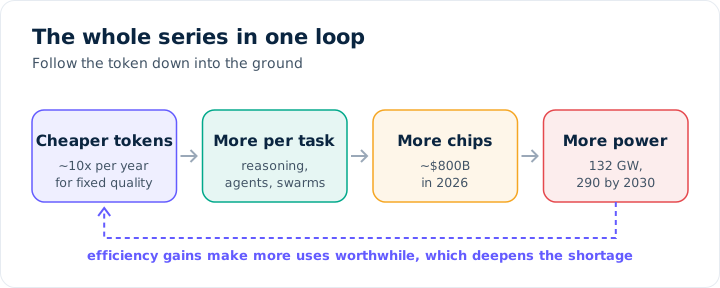
Nine weeks, one loop. Here is the whole series in five moves.
1. Start from the token
A token costs what it costs because of how many weights it passes through, what the chip charges per operation, and how busy the chip is kept. Six levers push that cost down, and the strongest is fitting more intelligence into fewer weights. (Parts 2 and 3.)
2. Split the picture in two
Yesterday's intelligence gets cheap very fast. Today's best intelligence stays expensive. Both are true at once, and most confusion about AI pricing comes from mixing them up. (Part 4.)
3. Apply Jevons
Cheap tokens did not cut the bill. They created reasoning models, agents and swarms, each of which uses far more tokens per task. Volume outran price, and total spending rose. (Parts 1 and 5.)
4. Follow the tokens down into the ground
Volume needs chips, chips need buildings, buildings need power, and power is what is scarce now. That is why software companies are signing nuclear contracts and why the industry is spending the better part of a trillion dollars a year. (Part 6.)
5. Hold the two open questions separately
One is technical: do agents become dependable across many kinds of work? The other is financial: does revenue grow into the capital already committed? They are linked, since the first largely decides the second, but they can come apart in the short run. A financial correction would not mean the technology failed, and continued technical progress would not guarantee every investor is repaid. (Parts 8 and 9.)
Coda: Jevons was right about the mechanism, wrong about the ending
Britain did not run out of coal. Oil arrived, then gas, and the constraint moved elsewhere.
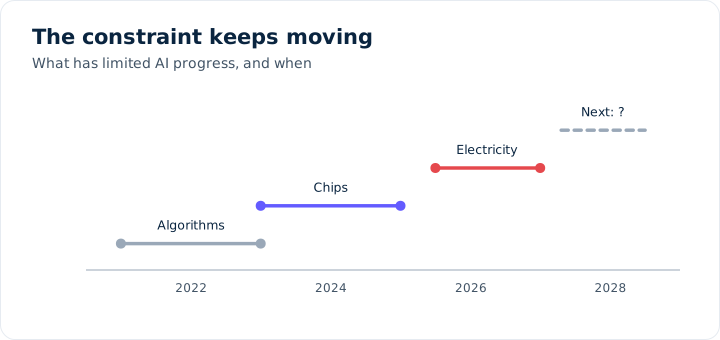
Constraints in this industry have already moved from algorithms to chips to electricity in four years. The reasonable expectation is that they will move again, to somewhere few people are looking at today.