Part 4 of 10 in The Price of a Thought. Last week: six levers and a 600-fold price collapse.
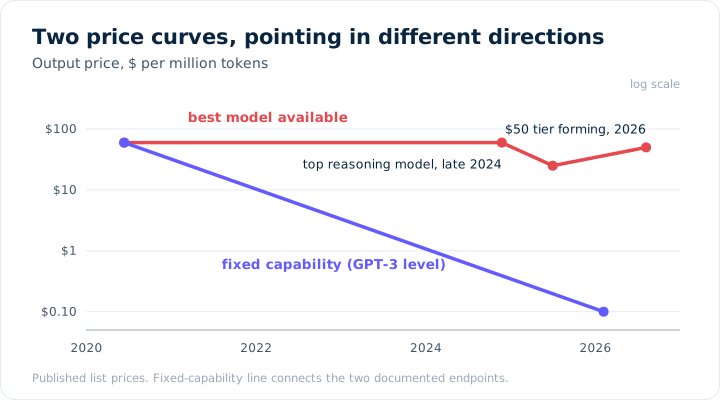
Most summaries of AI pricing stop at the collapse. They miss that there is not one price curve for AI. There are two, and they point in different directions.
Curve one: a fixed level of capability
Pick any level, say as good as the best model of early 2024, and track the cheapest way to buy it. That curve is in free fall, for all the reasons in Part 3.
Curve two: the best model available
That curve has been flat, and lately it has risen.
- Late 2024: OpenAI's top reasoning model charged $60 per million output tokens, the same as GPT-3 at its launch four years earlier.
- 2025: the flagship tier settled around $25 per million output.
- 2026: a new tier is forming above it. Earlier this year, OpenAI's GPT-5.5 came out at double the rate of its predecessor, and the next wave of flagships is being priced at $10 in and $50 out, double the $5/$25 of the tier below.
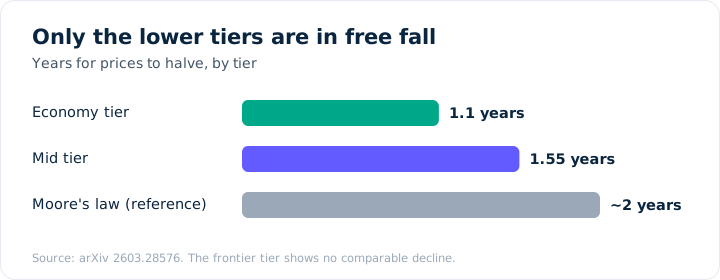
An academic study of pricing data put numbers on the split. Economy and mid-tier prices are halving every 1.1 and 1.55 years, faster than Moore's law, but the super-fast decline is confined to those tiers. The frontier does not follow it.
Why the best model gets dearer
Because the labs keep spending the efficiency gains on capability. Each generation, they could ship the same intelligence at a tenth of the price, and they do, as the cheap tier. They also build something larger and more capable at the top, and it turns out there are buyers for whom the top model is worth almost any price. If a model can do in an afternoon what a senior engineer does in a week, the difference between $25 and $50 per million tokens is noise.
The result: a 600-fold spread
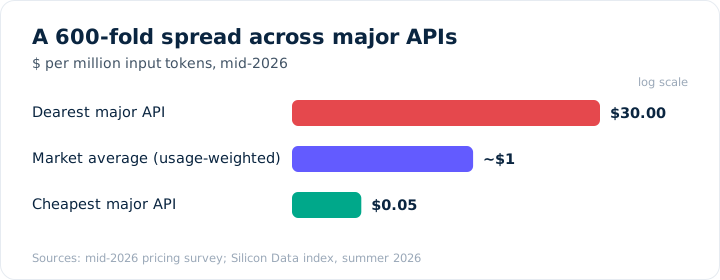
One mid-2026 survey found a 600-fold gap between the cheapest and dearest major APIs, from five cents to $30 per million input tokens. The market has organized itself into tiers: a top model for the hardest work, a mid model for everyday work, and a small fast model for volume. Most serious users now route between tiers, sending each task to the cheapest model that can handle it.
If you want a single number for what the market pays on average, a usage-weighted index from Silicon Data has been sliding to record lows, around a dollar per million tokens this summer. That average sits far below flagship list prices because the bulk of tokens flow through the cheap tiers.
For a team building on these models, the practical upshot is that which model you pick is a cost decision as much as a quality decision. Sending every request to the flagship is the most common way we see AI bills run away.
Next week: if tokens got a hundred times cheaper, where did the savings go?