Part 6 of 10 in The Price of a Thought. Last week: where the savings went.
Tokens are made in buildings, and the demand curve from last week has to be met with concrete, copper and silicon. This is where the numbers become difficult to picture.
The spending
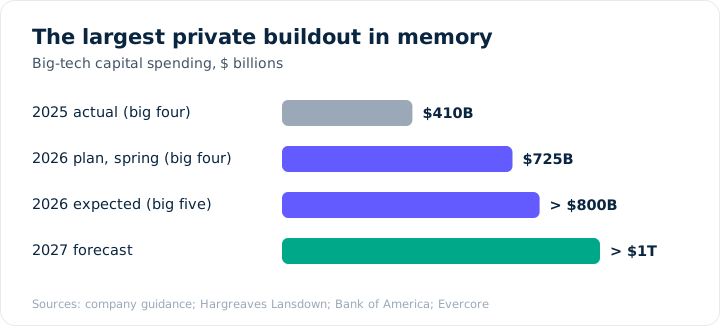
By spring 2026 the four largest cloud companies, Alphabet, Amazon, Microsoft and Meta, had lifted their combined capital spending plans for the year to about $725 billion, 77% above 2025's record $410 billion. The figure kept climbing through the summer, and analysts now expect the five biggest spenders to finish 2026 above $800 billion. Bank of America and Evercore expect the total to pass $1 trillion in 2027.
Where it goes
Roughly a third of data center spending goes on GPUs and custom accelerators. The rest is buildings, power equipment, cooling, networking and memory. Component prices themselves are rising under the demand: Microsoft attributed about $25 billion of its 2026 capital budget to component price inflation alone.
The strain
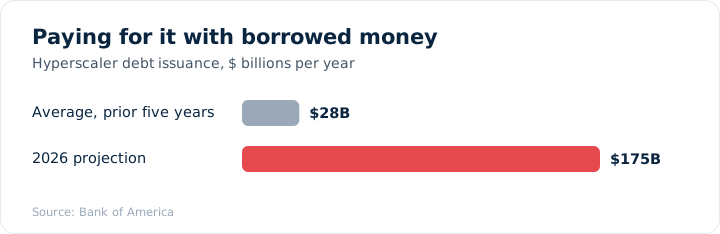
This is eating the cash flows of the richest companies in the world. Amazon's trailing free cash flow fell to about $1 billion, down 95%, as capital spending nearly matched operating cash flow. The companies are borrowing. And chips wear out or go obsolete in a few years, so this is not a one-time build. It has to be re-earned continuously.
The revenue
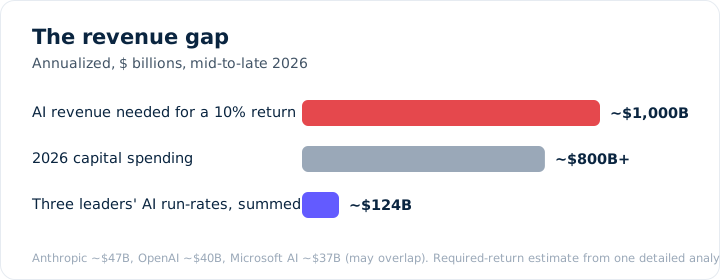
Is there income to justify it? There is real revenue, growing at rates rarely seen. Anthropic's annualized revenue went from roughly $9 billion at the end of 2025 to $47 billion by mid-May 2026, having been about $1 billion in December 2024. OpenAI's climbed to around $40 billion over a similar stretch. Microsoft reported AI revenue above a $37 billion annual run rate, and Google Cloud's backlog passed $460 billion.
But set those against the spending. One detailed analysis estimates that $700 billion a year of capital spending needs something like $1 trillion a year of AI revenue to earn a 10% return. The industry is at a fraction of that.
Whether it does is the central financial question in technology today, and reasonable people disagree. Bulls point to the revenue growth rates and the fact that every provider says it is short of capacity. Bears point to the gap, the debt, and the history of infrastructure booms (railways, fiber optics) that built real and lasting assets while wiping out many of the investors who paid for them.
The power
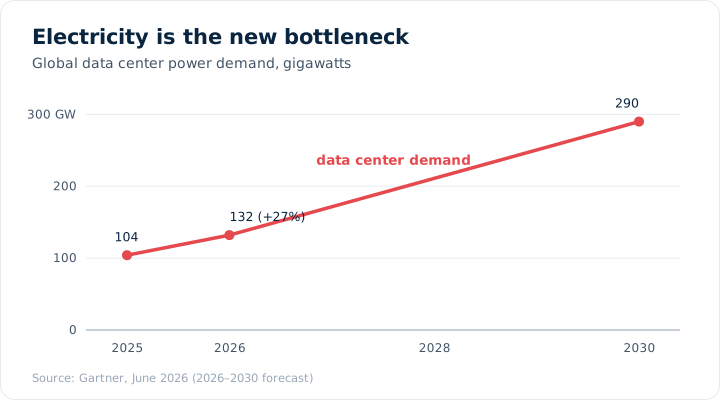
In 2023 and 2024 the scarce input was chips. In 2026 it is electricity. Gartner puts global data center power demand at 132 gigawatts this year, up 27% from 104, heading for 290 by 2030. AI servers account for 31% of data center electricity use in 2026 and are forecast to overtake conventional servers in 2027.
Individual sites have become city-sized loads. Five AI facilities are expected to reach gigawatt scale in 2026, each drawing about what a nuclear reactor produces. Meta's Hyperion campus in Louisiana is designed for five gigawatts. A single rack of AI servers now draws as much power as 80 to 100 homes.
The grid cannot keep pace. Connecting a large new load can take years of permitting and construction of transmission lines and transformers. One grid analysis counts roughly 2,600 gigawatts of proposed generation and storage waiting in the US interconnection queue. So the companies are going around the grid: building gas turbines on site, and signing long contracts with nuclear plants. About 30 gigawatts of nuclear deals have been announced in two years.
The constraint is already visible in the accounts: Microsoft trimmed its 2026 spending outlook because third-party data center capacity was delayed. It had the money and could not get the buildings.
What efficiency means now
When power is the fixed quantity, the metric that matters is tokens per watt. A chip that makes ten times the tokens from the same electricity is worth a great deal even at a high price, which is precisely the case Nvidia makes for Rubin. It also means efficiency gains do not relieve the power shortage. By Jevons's logic they deepen it, because each gain makes more uses worthwhile.
Next week: with the mechanics in place, who's who in the AI stack.