Part 1 of 10 in The Price of a Thought, a weekly series on how cheap tokens shaped the AI landscape of 2026, and where it goes next.
The argument of this series, in one paragraph
The cost of producing a fixed amount of machine intelligence has been falling about tenfold a year. That did not shrink the AI industry's bills. It did the opposite: it made it worthwhile to spend hundreds or thousands of times more tokens per task, which turned chatbots into agents, turned software companies into the largest builders of physical infrastructure on earth, and moved the bottleneck from algorithms to chips and then to electricity. Almost everything in today's landscape follows from that one loop. Over the next ten weeks we'll take it apart piece by piece. This week starts in Victorian England.
1865: a book about coal
In 1865 a young English economist named William Stanley Jevons published a book about coal. Britain ran on it, and people worried about running out. The comforting view at the time was that engineers would save the country: engines were getting more efficient every decade, so each ton of coal would stretch further and the supply would last.
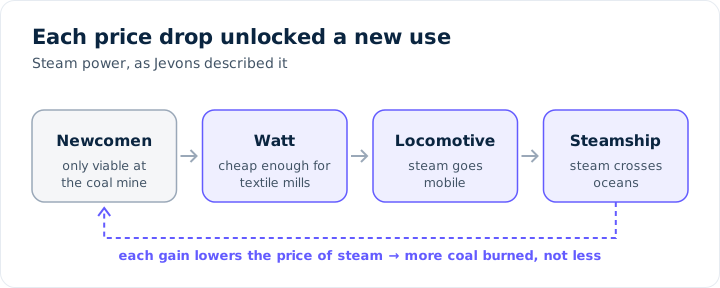
Jevons looked at the history and saw the reverse. James Watt's steam engine used a fraction of the coal that the earlier Newcomen engine needed for the same work. If efficiency reduced consumption, coal use should have dropped after Watt. Instead it exploded.
The old engine was so wasteful that it only made sense at the mouth of a coal mine, pumping water. Watt's engine was cheap enough to run that it made sense in a textile mill, then in a locomotive, then in a ship. Every gain in efficiency lowered the effective price of steam power, and every drop in price opened uses that had not been worth doing before.
The paradox, and its one condition
That is the Jevons paradox: making a resource more efficient to use can increase total consumption of it.
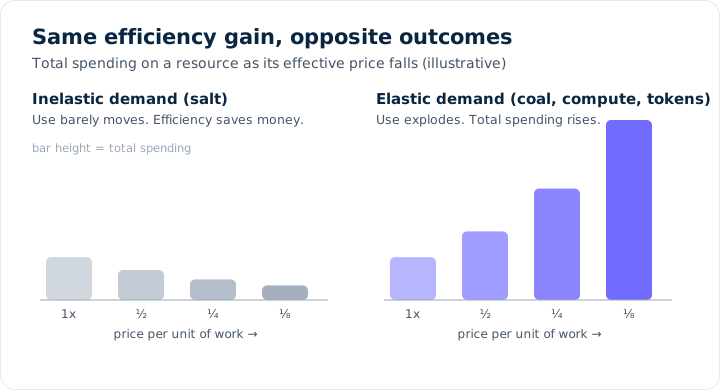
It is not a law of nature. It depends on one condition, which economists call elastic demand. If people want only so much of something no matter the price (table salt is the usual example), efficiency just saves money. But if there is a deep reservoir of uses waiting just above the current price, then every price cut taps more of the reservoir, and total spending rises.
It has happened before, many times
- Lighting behaved this way, from candles to LEDs.
- Computing has behaved this way for sixty years: a transistor costs a tiny fraction of what it did in 1970, and the world spends vastly more on transistors.
- Bandwidth behaved this way through the dotcom era and after.
The question that matters for AI
So the important question about AI is not how fast it is getting cheaper. It is how deep the reservoir is. How many things would people have a machine think about if thinking cost a tenth as much, or a thousandth?
The evidence of the past two years is that the reservoir is very deep. If you run an engineering team, you have probably felt it already: the tools got cheaper per call, your team found ten times as many things to point them at, and the line item went up.
To see why the reservoir is so deep, we first need to look at what a unit of machine thinking physically is. That's next week: what you're actually buying when you buy a token.