Part 9 of 10 in The Price of a Thought. Last week: agents, the promise and the gap.
What follows is our reading of where the trends point. Some of it is close to arithmetic. Some of it is uncertain, and we'll say which.
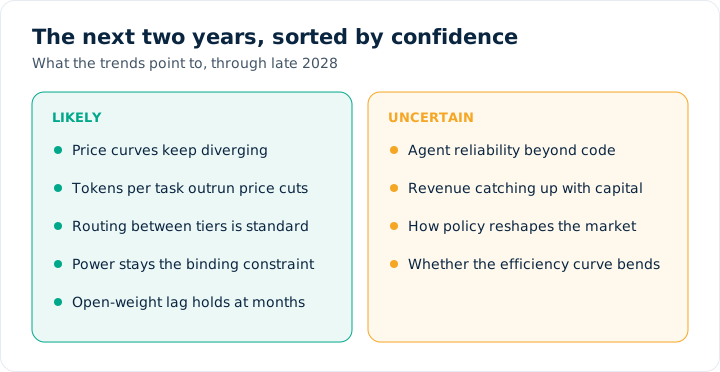
Likely
The two price curves keep diverging. Capability at any fixed level will keep getting cheaper, as distillation continues and new chips arrive. The half-lives measured so far suggest today's mid-tier quality costs a fraction as much by late 2028. At the same time, the top tier will stay expensive or get more so, because labs will keep building bigger models and customers will keep paying for the best. Expect the spread between cheapest and dearest to widen.
Tokens per task keep rising faster than price falls. Longer agent runs, more parallel agents, more background work. Total token volume has years of steep growth ahead even on conservative forecasts. Jevons holds until the reservoir of unmet uses runs dry, and there is no sign of that yet.
Routing becomes standard practice. With a 600-fold price spread and capable small models, sending every request to the flagship is wasteful. The normal architecture becomes a small local or cheap model handling most steps and escalating the hard ones. Skill in deciding which model gets which task becomes a real source of cost advantage.
Power stays the binding constraint. Demand for data center power is forecast to more than double by 2030, and grid construction cannot accelerate much. Expect more on-site gas generation, more nuclear contracts, more data centers sited where power is available instead of where people are, and more political argument over electricity prices and who pays for grid upgrades. Access to energy becomes a competitive moat in its own right.
The open-weight gap persists at a few months. Nothing in the last eighteen months suggests it will close or widen sharply. That means any capability that is frontier-only today is a cheap commodity within a year. Planning around that lag is one of the most useful habits in this field.
Uncertain
Whether agent reliability generalizes beyond code. If the task-length curve keeps its recent pace and reliability follows, then by 2028 models could dependably carry out multi-day projects in many fields, and the economic effects would be large. If reliability lags, agents remain powerful tools that need supervision, which is still valuable but a different world. The measurement itself is getting harder, since the benchmarks were built for shorter tasks.
Whether revenue catches up with capital. This is the bubble question. One path: revenue keeps multiplying, the spending is vindicated, and the constraint remains supply. Another: growth slows, a major spender cuts its budget, and financing tightens.
Note what a correction would and would not mean. The dotcom crash destroyed investors and left behind the fiber that the modern internet runs on. An AI capital correction would hurt suppliers and lenders, and it would probably make tokens cheaper for a while, as idle capacity is sold at a discount. The technology would not go away. Watch for a year-over-year cut in spending guidance from one of the big four. That would be the clearest signal.
How policy shapes the market. Export controls, safety rules and data center permitting are all in motion, and they can change availability overnight. Labs are also making their own release decisions on safety grounds, and at least one major lab has said publicly that it would hold back a model that did not meet its safety standards. As models get more capable, more of them may be held back, restricted or released in limited form.
Whether the efficiency curve bends. Distillation has been compressing a backlog of capability into small models. At some point small models approach the limit of what their size can hold, and the tenfold-a-year decline slows toward the hardware rate, which is much lower. The study that measured the halving times found the fast decline only in the lower tiers, which fits this picture. If the curve does bend, the Jevons loop weakens, and demand growth has to come from capability instead of price.
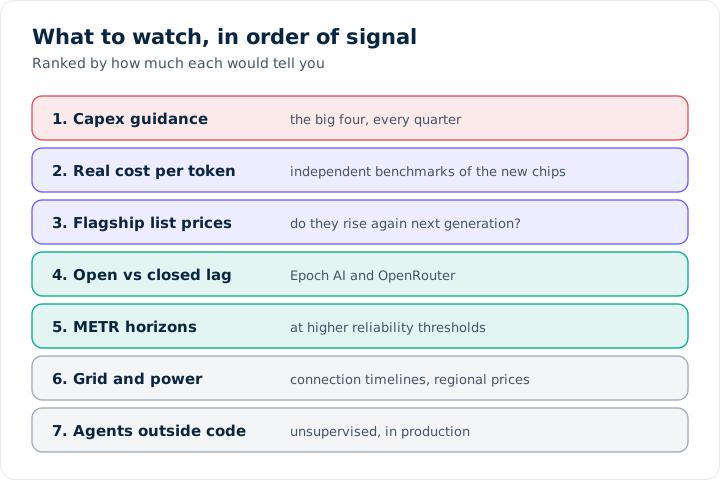
What to watch
Next week, the finale: how to hold all of this in your head at once.