Part 8 of 10 in The Price of a Thought. Last week: who's who in the AI stack.
Agents deserve their own post, because they are both the main source of token demand and the main source of confusion.
The promise: a seventeenfold jump
The best single measure of progress comes from METR, a research group that tests how long a task an AI can complete on its own. They express it in human time: the length of task, as timed for a skilled person, that a model finishes successfully half the time.
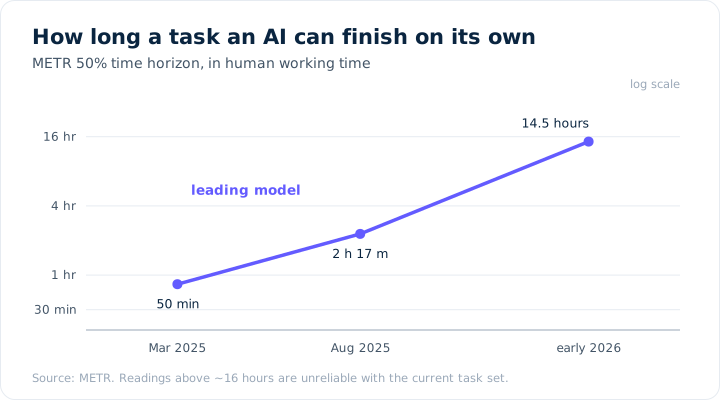
In March 2025 the leading models stood at around 50 minutes. GPT-5, in August 2025, reached about 2 hours 17 minutes. By early 2026, Claude Opus 4.6 sat at 14.5 hours.
The original finding was a doubling roughly every seven months since 2019. METR's January 2026 revision, with more long tasks in the test set, found coding horizons doubling about every four months through 2024 and 2025.
Two cautions apply. METR itself warns that readings above 16 hours are unreliable with its current tasks, so the measuring stick is running out. And succeeding half the time is a low bar. The length of task a model completes reliably, say four times in five, is much shorter.
The gap: possible versus dependable
That gap between possible and dependable explains the odd state of enterprise adoption. Surveys of whether companies use agents return very high numbers. Surveys of what is working return much lower ones.
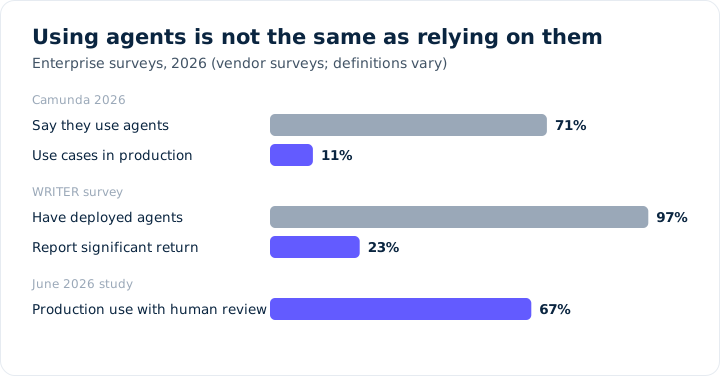
Camunda's 2026 study found 71% of organizations saying they use agents, while only 11% of agent use cases had reached production in the prior year. A survey by WRITER found 97% of companies had deployed agents and 23% reported significant return. Where agents do run in production, people usually stay in the loop: one June 2026 study of enterprise AI teams found two-thirds of production deployments included mandatory human review.
The exception: code
Software engineering is where agents have plainly crossed into daily use. Code is the ideal territory.
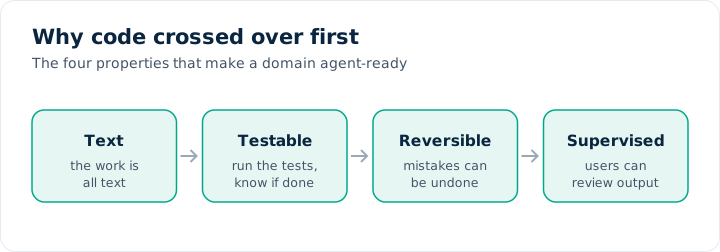
That is why coding accounts for so much of the labs' revenue growth.
Why agents stall elsewhere
The reasons are mostly not about intelligence. They are about permissions, security, connections to messy internal systems, the absence of a clear test for done, and accountability when something goes wrong. Those are organizational problems, and they move at organizational speed.
That is also the work we spend most of our time on. Getting an agent from demo to production is rarely a model problem. It's wiring, testing, and a human who owns the result.
Next week: the next two years, sorted into what's likely and what's genuinely uncertain.