Part 5 of 10 in The Price of a Thought. Last week: two price curves, pointing in opposite directions.
Now the Jevons part. If tokens got a hundred times cheaper in two years, did AI bills fall by 99%? No. Usage grew faster than price fell.
The volume
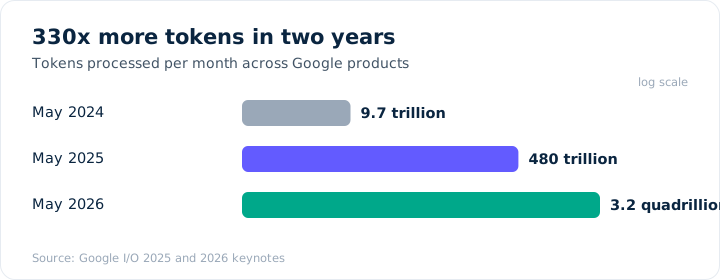
Google publishes the clearest series. Across its products it processed 9.7 trillion tokens a month in May 2024, 480 trillion in May 2025, and 3.2 quadrillion in May 2026. That is a 330-fold increase in two years, and about sevenfold in the most recent year alone.
Other vantage points show the same slope. OpenRouter, a marketplace that routes requests across many models, saw weekly volume go from 5 trillion to 25 trillion tokens in six months. Goldman Sachs forecasts 47 quadrillion tokens a month industry-wide by 2028.
It isn't mostly more users
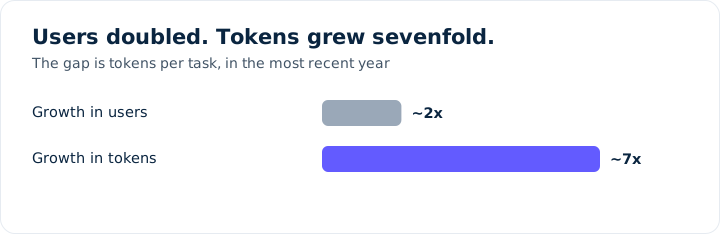
Consumer use is vast: ChatGPT had 900 million weekly users by February 2026 and the Gemini app passed 900 million monthly users. But user counts roughly doubled while tokens grew sevenfold. The rest is tokens per task, and that is where cheap tokens changed what AI is.
Four ways a task got hungrier
Reasoning. Starting in late 2024, models began thinking before answering: writing out long internal chains of reasoning, checking them, and only then replying. The thinking is made of tokens, and you pay for them. Reasoning models are estimated to burn 10 to 40 times more tokens per query. This only became a sensible product once tokens were cheap enough to spend thousands of them on a question that used to get a few hundred.
Agents. A chatbot answers and stops. An agent is a model running in a loop: it reads the situation, decides on an action (open a file, run a command, search, click), sees the result, and decides again. A coding agent fixing a bug may read dozens of files, run the test suite ten times, and rewrite its patch four times. Every step re-reads a long context. A single task can consume millions of tokens.
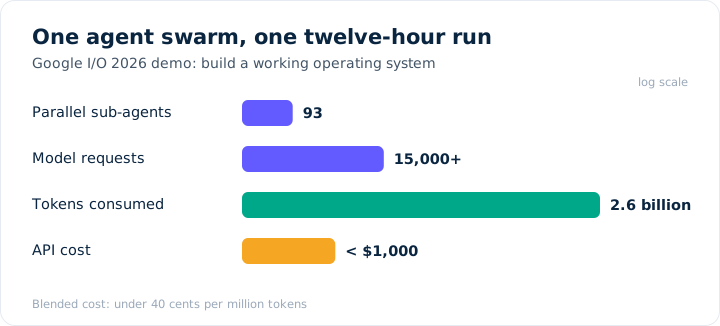
Parallelism. Once agents work, you can run many at once. Google showed a run at its 2026 developer conference in which 93 parallel sub-agents worked for 12 hours, made more than 15,000 model requests, and consumed 2.6 billion tokens to build a functioning operating system, for under $1,000 in API credits. That works out to under forty cents per million tokens, blended. At 2023 prices the same run would have cost a small fortune, and no one would have tried it.
Background work. Cheap tokens also make it affordable to have models work when nobody is asking: triaging every email, reviewing every pull request, reading every contract and support ticket instead of a sample, grading other models' outputs, generating synthetic training data.
The scale of individual consumption can be startling. One compilation of industry disclosures records a single OpenAI employee using 603 billion tokens in thirty days. That is one person directing a swarm.
The squeeze
This is the Jevons loop in its purest form. Cheaper tokens did not mostly make chat cheaper. They made it rational to spend a hundred or a thousand times more tokens on each piece of work, because the work got better when you did.
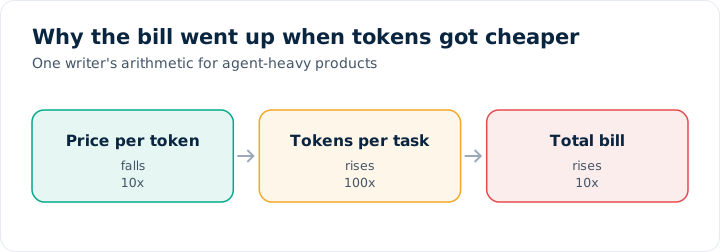
One industry writer summarized the squeeze on AI application companies this way: per-token prices fell tenfold while consumption for some workloads rose a hundredfold, so the bill went up tenfold.
There is a subtler trap too. The cheapest model per token is not always the cheapest per task. A weak model may need three attempts, longer prompts and more hand-holding, and still fail. The measure that matters is cost per completed task, and on hard tasks the expensive model often wins.
Next week: tokens are made in buildings. The physical layer: chips, money and electricity.