Part 7 of 10 in The Price of a Thought. Last week: chips, money and electricity.
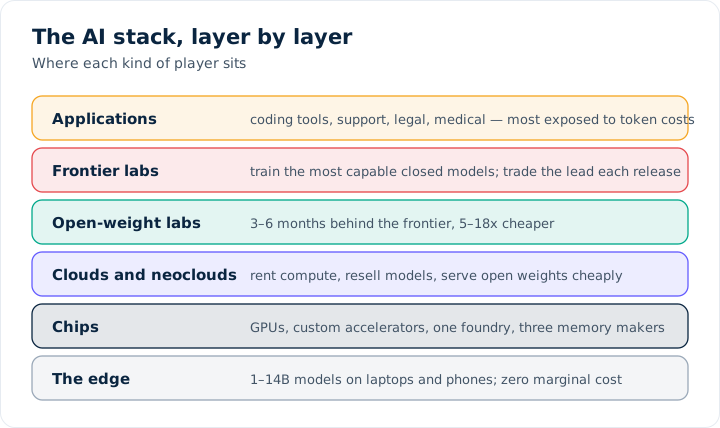
With the mechanics in place, the map of players makes sense. Here it is from the top of the stack to the bottom, and then out to the edge.
The frontier labs
A handful of companies train the most capable models: OpenAI, Anthropic, Google and xAI in the United States. They trade the lead from release to release, and the gaps between them are small. The cadence is relentless: a new flagship from one of them every few weeks, each followed by price cuts on the older tiers, with mid and small models sometimes relaunched at half the price of the versions they replace.
The business models differ in ways that matter. OpenAI has the largest consumer audience. Anthropic's growth has come mostly from businesses and developers, with coding as the engine: its coding agent alone was at a $2.5 billion annualized rate by February 2026, and by mid-year the company was running neck and neck with OpenAI on annualized revenue. Google is the only player that owns every layer, from its own chips through its own models to products with billions of users, which gives it a cost position the others cannot easily match.
The open-weight labs
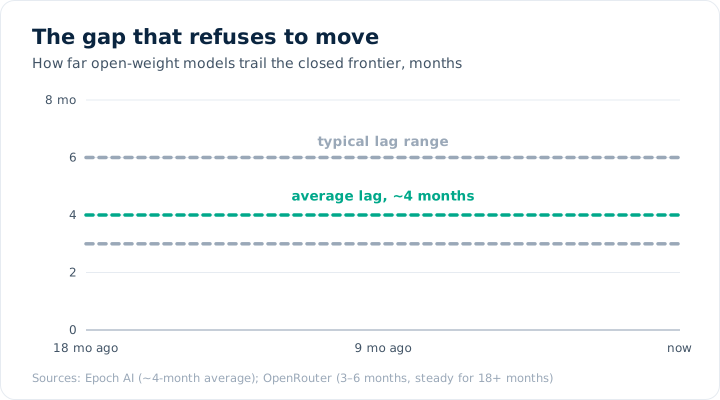
Behind the frontier, by a few months, sit models anyone can download and run. The strongest now come predominantly from Chinese labs, led by DeepSeek and Alibaba's Qwen. Epoch AI's measurement has them trailing the closed frontier by an average of about four months, and OpenRouter's analysis finds the lag has held steady at three to six months for over eighteen months. The frontier is not pulling away, and the followers are not catching up.
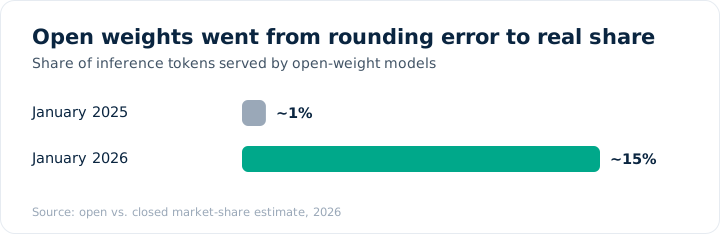
The price difference is large. A like-for-like comparison this year found closed models costing 5 to 18 times more than open ones, depending on tier. Usage has shifted accordingly: one estimate has open-weight models going from about 1% of inference tokens to about 15% in the twelve months to January 2026.
What the remaining gap buys is mostly reliability. On benchmarks the open models look nearly level. In long, unattended, multi-step work, the top closed models fail less often, and in agent work a small difference in per-step reliability compounds into a large difference in whether the job finishes. That is why customers still pay frontier prices for the hardest tasks while moving routine volume to cheap models.
There is also a geopolitical layer. Chinese labs work under US export controls on advanced chips, which pushes them toward efficiency and toward releasing weights openly as a way to win global adoption. Much of the world outside the US and China is deciding which ecosystem to build on, and price is a strong argument.
The clouds and the neoclouds
Amazon, Microsoft and Google rent compute and resell models. Around them a second group has grown up that does nothing but AI compute: CoreWeave and its peers, plus specialist inference hosts that serve open models at very low prices or very high speeds. These hosts are the mechanism by which open weights turn into price pressure.
The chip makers
Nvidia remains the center, supplying the general-purpose GPUs that train nearly everything. Its position on inference is less absolute. Custom chips designed for a single company's workload are a fast-growing share: Amazon's chip business alone has reached a $20 billion revenue run rate. Behind all of them sit a few chokepoints: TSMC, which fabricates nearly every advanced chip, and the three firms that make high-bandwidth memory.
The edge
At the far end from the gigawatt campus is the model on your own device. Small models of 1 to 14 billion parameters now run on laptops and phones and can match much larger models on specific, bounded tasks. A 3.8-billion-parameter model fits in 8 GB of memory when quantized to four bits. A token generated locally has no marginal price, needs no network and sends no data anywhere. The emerging pattern is a hybrid: the device handles frequent, simple, private requests and passes hard ones to the cloud. This is the same distillation story from Part 3, carried to its conclusion.
The application layer
On top of all this sit the companies that turn models into products: coding tools, customer support systems, legal and medical software, and thousands more. Their position is the most exposed. Their main input cost is tokens, their suppliers also compete with them, and the Jevons loop means their costs rise when they improve their product.
The ones doing well tend to own something the model providers lack: proprietary data, a workflow customers are embedded in, or deep knowledge of one industry. If you're building AI into your own product, that list is the checklist.
Next week: agents, the main source of token demand and the main source of confusion.