Part 8 of 8, the finale of The Last Mile of Enterprise AI. Last week: the economics of a senior pod.
The previous posts can be read as separate services. They work better as one cycle in which each part feeds the next.
The cycle
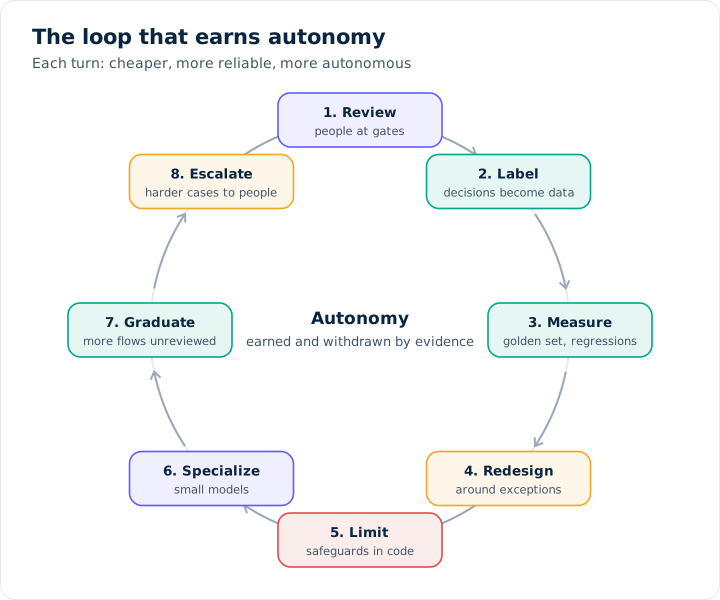
- 1. The client's experts review the system's work at defined gates (Part 1).
- 2. Their decisions become labeled data.
- 3. The data builds the golden dataset and catches regressions (Part 2).
- 4. Measured reliability lets you redesign the workflow around exceptions (Part 3).
- 5. Safeguards in code set hard limits on what the system may do (Part 4).
- 6. Accumulated examples train small specialist models that are cheaper and can run in-house (Part 5).
- 7. With quality proven and limits enforced, more cases flow through without review.
- 8. Reviewers move to harder cases, which produce the next round of data.
Autonomy is earned by evidence and can be withdrawn by evidence. A step graduates from full review to sampled review when its numbers justify it, and goes back if they slip.
That answers the question executives ask: when can we remove the humans? The better question is which decisions still need them, and what evidence would change that.
A first engagement, in outline
The shape that works is narrow and time-boxed: one workflow, about a month for a pilot, success measures agreed in writing before any code, everything on infrastructure the client owns, and a fixed price. A fuller ninety-day path follows.
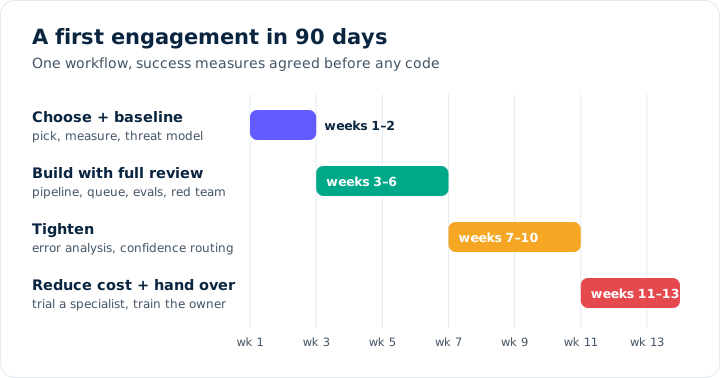
Weeks 1 to 2: choose and baseline. Pick one workflow using the criteria from Part 3. Record current volume, cycle time, error rate and cost per case. Agree targets. Write the threat model. Hold recorded walkthroughs with the client's experts, and have them supply correct answers for a first set of real cases. If the pod is remote, this is the stage for an on-site visit.
Weeks 3 to 6: build with full review. Stand up the pipeline with a frontier model. Build the review queue with every output checked by the client's staff. Build the golden dataset and the release gate. Put permissions, tool limits and logging in place. Run a red-team pass. By the end, the system is doing real work with every item reviewed, and pilot numbers can be set against the baseline.
Weeks 7 to 10: tighten. Run error analysis weekly and fix the largest failure category each time. Add confidence routing so clean cases skip review. Move the first steps to sampled review as their numbers allow. Report the three productivity measures.
Weeks 11 to 13: reduce cost and hand over. Trial a specialist model on one high-volume step. Document everything. Train the client's owner to read the dashboards and run the evals. Decide together what comes next.
What the client should own at the end
Questions to ask any team offering this work
- Show me the evaluation suite from a past project.
- What happens when the model vendor ships a new version?
- Which actions need approval, and what does the reviewer see?
- What can the agent not do, and what enforces that?
- How do we know the productivity number is real, net of rework?
- Who reviews AI-written code before it ships?
- What is the price, what does it include, and who pays if tokens run over?
- Who is our named lead, and when are they reachable?
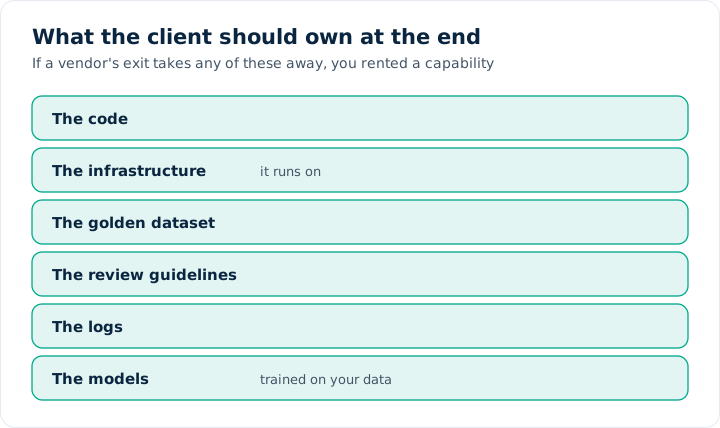
- What do we own if we stop working with you?
Why this matters now
Models are becoming cheap and widely available. Open models trail the best closed ones by a few months, and what is frontier-only today is a commodity within about a year. So the model is not where advantage will sit. It will sit in what cannot be downloaded: a redesigned workflow, labeled examples from your own operations, an evaluation suite that encodes what correct means in your business, and specialists trained on your data.
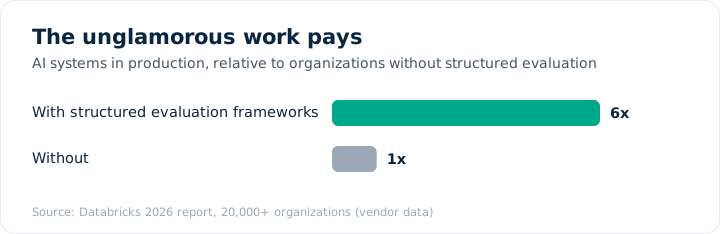
One 2026 Databricks report, covering more than 20,000 organizations, found companies using structured evaluation frameworks getting six times more AI systems into production.
The big AI companies have concluded that deployment needs engineers embedded with the customer, and they are spending billions to supply them to their largest accounts. A small senior pod offers the same thing to everyone else: forward deployed in practice, remote in location, neutral on models, and priced by the result.