Part 7 of 8 in The Last Mile of Enterprise AI. Last week: forward deployed, remotely.
For thirty years, technology services were sold by the head. A project needed so many people for so many months at a given rate. That arithmetic is breaking, and the break is the most direct business benefit of pairing a senior pod with AI.
What changed
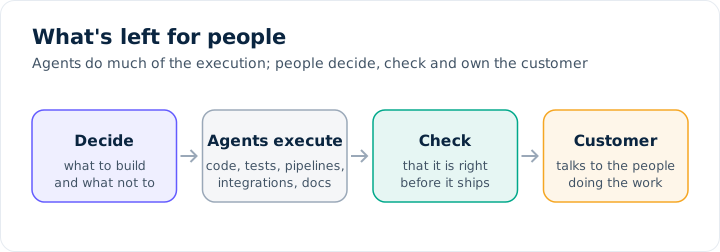
Agents now do much of the execution: writing code, tests, integrations, documentation, data pipelines. What remains for people is deciding what to build, checking that it is right, and dealing with the customer.
Forrester's assessment is blunt: large pyramid-shaped delivery structures are the ones being disrupted, because AI absorbs coordination overhead and compresses execution work.
One services leader, speaking at an industry conference, described the result: an outcome-based project staffed with three engineers, where compute, not engineering talent, was the largest delivery cost.
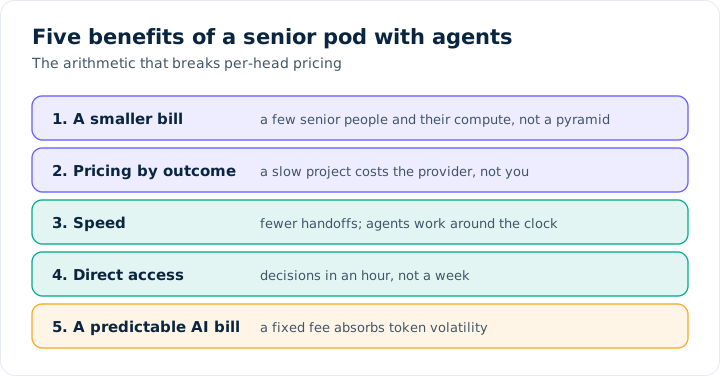
Benefit one: a smaller bill for the same result
The client pays for a few senior people and their compute, not for a pyramid of juniors, their managers and the meetings that hold them together.
Benefit two: pricing by outcome
If cost no longer tracks headcount, pricing by headcount stops making sense. The market is moving accordingly.
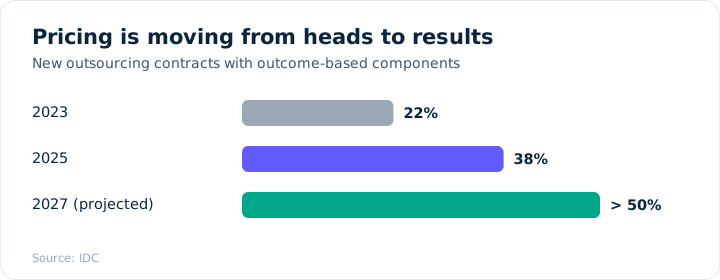
- IDC reports 38% of new outsourcing contracts in 2025 included outcome-based components, up from 22% in 2023, and projects more than half by 2027.
- HFS Research expects most large outsourcing deals signed before the agent era to be renegotiated within two years, with talks shifting from rate cards and offshore ratios to productivity commitments and gain-sharing.
For the buyer this is a transfer of risk. With time-and-materials, a slow project costs the client more. With a fixed fee per deliverable, it costs the provider.
Benefit three: speed
One firm running small engineer-plus-agent pods under fixed-price contracts reports a 38-day median delivery against more than 120 days before.
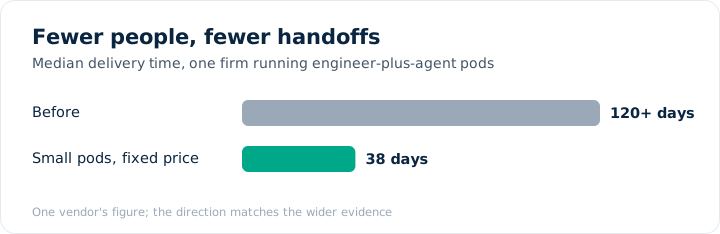
Fewer people means fewer handoffs, and agents work around the clock.
Benefit four: direct access
In a three-person pod, the client talks to the people doing the work. Decisions that take a week to travel up and down a large account team take an hour.
Benefit five: a predictable AI bill
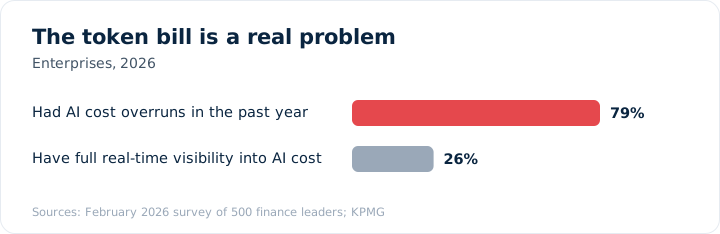
Token costs have become a real problem. A February 2026 survey of 500 finance leaders found 79% of enterprises had AI cost overruns in the past year, and KPMG found only 26% with full real-time visibility into what their AI costs to run. Gartner expects coding agent costs to pass the average developer's salary by 2028.
A pod that quotes a fixed fee absorbs that volatility, and it has every reason to manage it well through routing, caching and cheaper models where they suffice. Coinbase's chief executive said in June that the company nearly halved its AI spend while usage kept growing, by exactly those methods.
The honest limits
Scope must be definable. One outsourcing firm puts it plainly: outcome pricing only works when the scope is well defined, the same condition that makes any fixed-price project reasonable. This is why the first engagement should be one workflow with success measures agreed in writing.
Outcomes must be measurable. Everest Group reports outcome pricing moving from pilots to scale as AI makes results measurable enough to contract on, with governance and verified baselines now the binding constraint. That is the baseline from Part 3 and the evals from Part 2. Without them there is nothing to price against.
The provider carries real risk. If compute runs high or more human review is needed than planned, the provider's margin suffers. A buyer should ask how the pod estimates and controls its own costs, because a provider that misprices will cut corners or come back for more money.
Small teams have a single point of failure. If one of three engineers leaves, a third of the capacity goes with them. Documentation, shared code ownership and a named backup are fair things to require.
What to measure
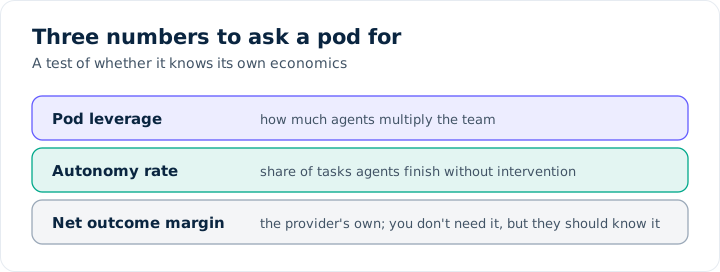
One research firm suggests three metrics for this kind of delivery: pod leverage (how much agents multiply the team), autonomy rate (the share of tasks agents complete without intervention), and net outcome margin.
Why seniority is the precondition
All of this depends on the people being able to direct agents well and catch what they get wrong. The Anthropic finding from Part 6 is the reason: experienced engineers succeed more often with agents. A pod of juniors with the same tools produces more code and more defects. The economics hold only when the few people involved are good.
The commercial pitch that follows is simple: a fixed price for one workflow in production, delivered in weeks by people the client can talk to, with the token bill included.
Next week, the finale: Putting it together: the loop that earns autonomy.