Part {n} of 8 in The Last Mile of Enterprise AI. Last week: reliability, from a demo that works to a system you can trust.
There is a puzzle in the data. Studies of individual tasks show large gains from AI. Studies of whole companies show very little.
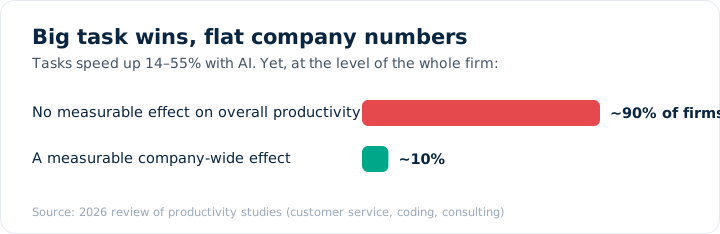
One 2026 review puts task-level gains at 14% to 55% across customer service, coding and consulting, while roughly 90% of firms report no measurable effect on overall productivity.
Where the gains go
Three leaks account for most of the gap.
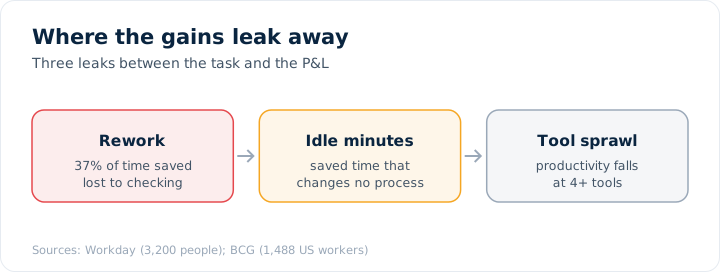
Rework. AI output has to be checked and often fixed. A Workday study of 3,200 employees and leaders found 37% of the time saved by AI lost again to rework. If writing a report takes two hours less but checking it takes forty-five minutes more, the true saving is smaller than the dashboard says.
Saved minutes that go nowhere. If each person saves twenty minutes a day on email, no process got faster and no cost left the business. Much AI use clusters in communication and documentation, not in the work that produces revenue.
Tool sprawl. A BCG study of 1,488 US workers found productivity rising with up to three AI tools and falling sharply at four or more. Each added tool brings switching and checking costs.
There is also a perception gap. An NBER survey of nearly 750 executives found perceived productivity gains from AI consistently above measured ones.
What separates the winners
One variable shows up in study after study: whether the company rebuilt the work or bolted a tool onto it.
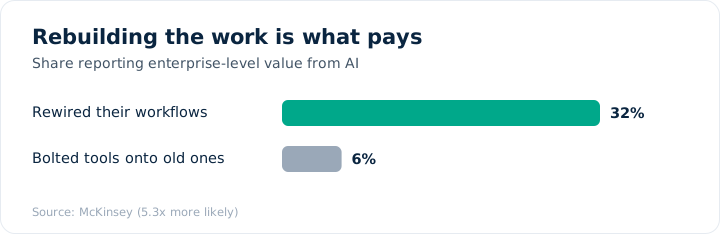
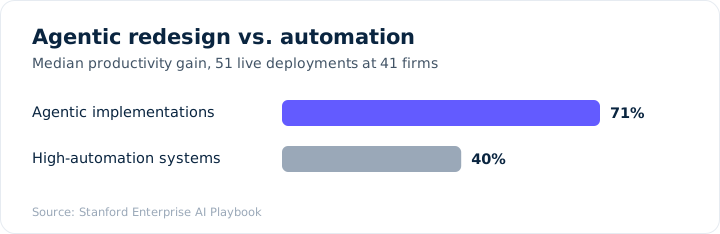
One review of large programmes found gains of 10% to 15% appearing only after formal job redesign and structured training.
The lesson is old. Electric motors did little for factories that swapped them in for steam engines and kept the same floor layout. The gains came when factories were rebuilt around what electricity allowed.
What redesign means in practice
Take a document-heavy process such as claims intake.
The bolted-on version: each processor gets an assistant. They paste in documents and ask questions. Work moves through the same queues, with the same handoffs, at the same pace.
The redesigned version: documents are read by the system on arrival. Fields are extracted and checked against policy data automatically. Clean cases move straight to the next stage. Cases with a mismatch or low confidence go to a reviewer, with the problem highlighted and the source text beside it.
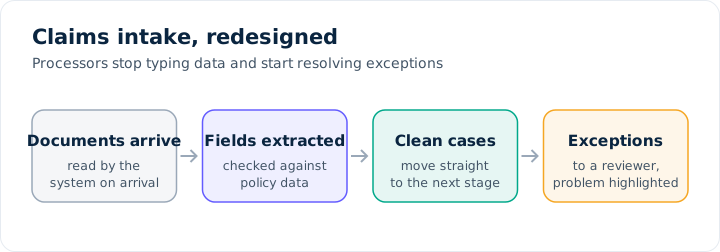
The second version changes roles, queues and metrics. That is why it works, and also why it is hard. It needs someone who understands both the process and the technology, and it needs the organization's agreement.
Measure the right thing
Three measures keep a project honest.
- Cost per completed task, counting retries, review time and escalations. As one adviser told InformationWeek, a smaller model can look cheaper while retries, human review and escalation to larger models erase the savings.
- Net time: time saved minus time spent checking and fixing.
- A process outcome: cycle time, backlog, error rate, cost per case. Something that appears in an operating report.
Set a baseline before changing anything. Many projects cannot show their value because nobody recorded the starting point.
Pick the right first workflow
Good candidates share some traits: high volume, clear rules, a definition of correct that people agree on, digital inputs, tolerable cost of error, and an owner who wants it fixed. Poor candidates are low-volume, judgment-heavy, politically contested, or dependent on data nobody can reach. Starting with one workflow and taking it all the way to production teaches more than ten pilots that stop at a demo.
Human review is part of productivity
It can look as if human review subtracts from the gain. Done well, it adds. A review queue that sends people only the exceptions lets one person oversee the output of many agents. Their corrections reduce future exceptions. Because someone is accountable for quality, the business is willing to let the system handle more. Without that confidence, adoption stays shallow, and shallow adoption is exactly what the flat company-level numbers show.
What a senior pod does here
The tech lead sits with the people who do the work, maps the process as it runs today, and finds where the hours go. The pod records the baseline, rebuilds the workflow around the system, and reports the three measures weekly. Because the pod builds the review queue and the evals too, rework is something it can see and reduce, not a hidden tax.
Productivity from AI is mostly an operations problem. The model is the easy part.
Next week: Safeguards: build the brakes before the engine.